

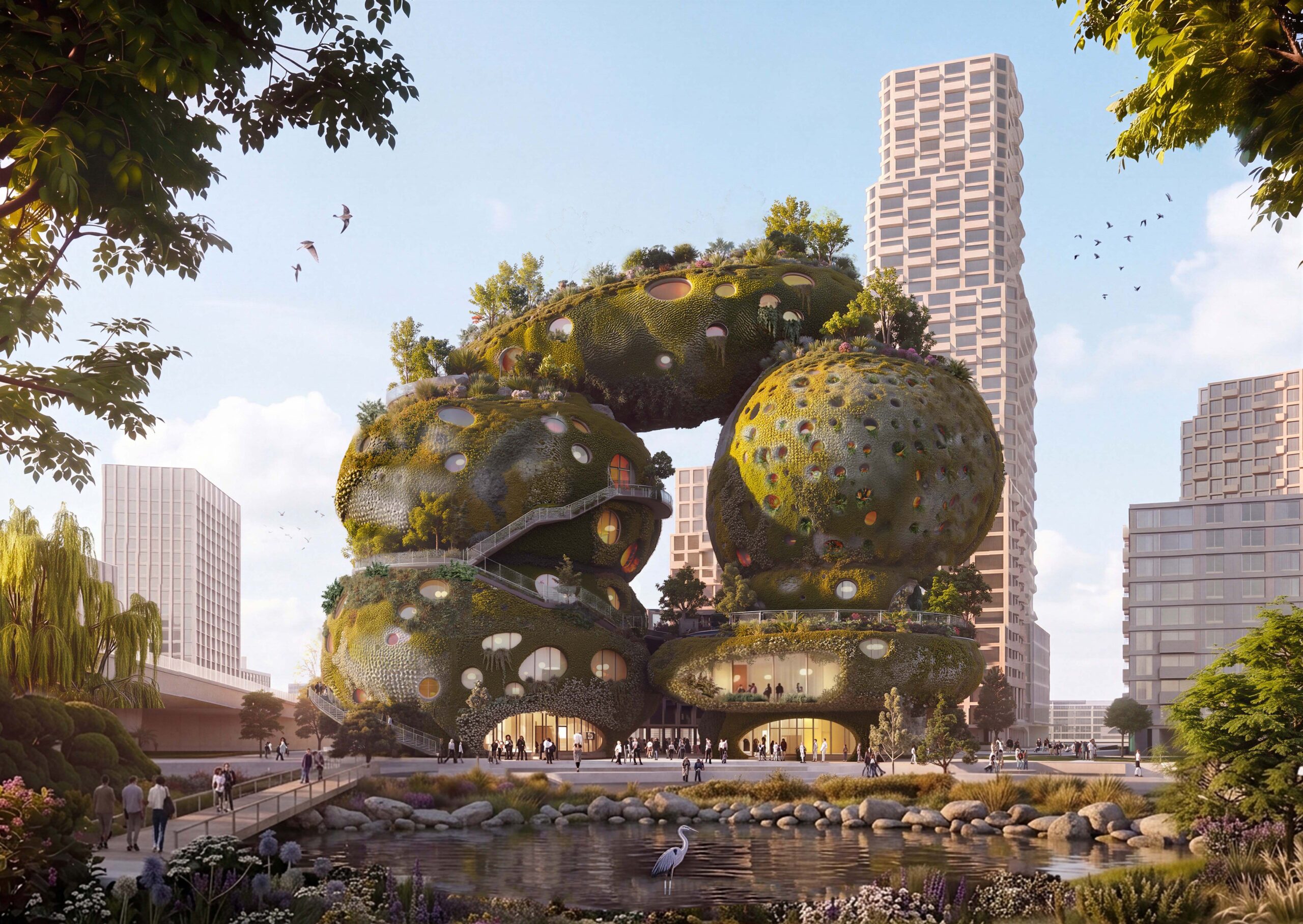
Located on the south bank of the Maas at the landing of Rotterdam’s future third city bridge, Rotterdam ROCKS! is the first Shift Embassy, initiated by the Shift Foundation to make sustainability visible, tangible, and actionable. Conceived by MVRDV, the project brings together an immersive exhibition, hospitality, conference facilities, landscape, research, and public space around urgent questions of climate, water, energy, resources, biodiversity, and responsible construction.
Rather than simply housing a story about sustainability, Rotterdam ROCKS! makes the building itself part of that story. Its architecture, materials, planted surfaces, water systems, energy strategy, public circulation, and monitoring technologies are designed to demonstrate how buildings can actively contribute to a more resilient urban environment.
The Green Maas
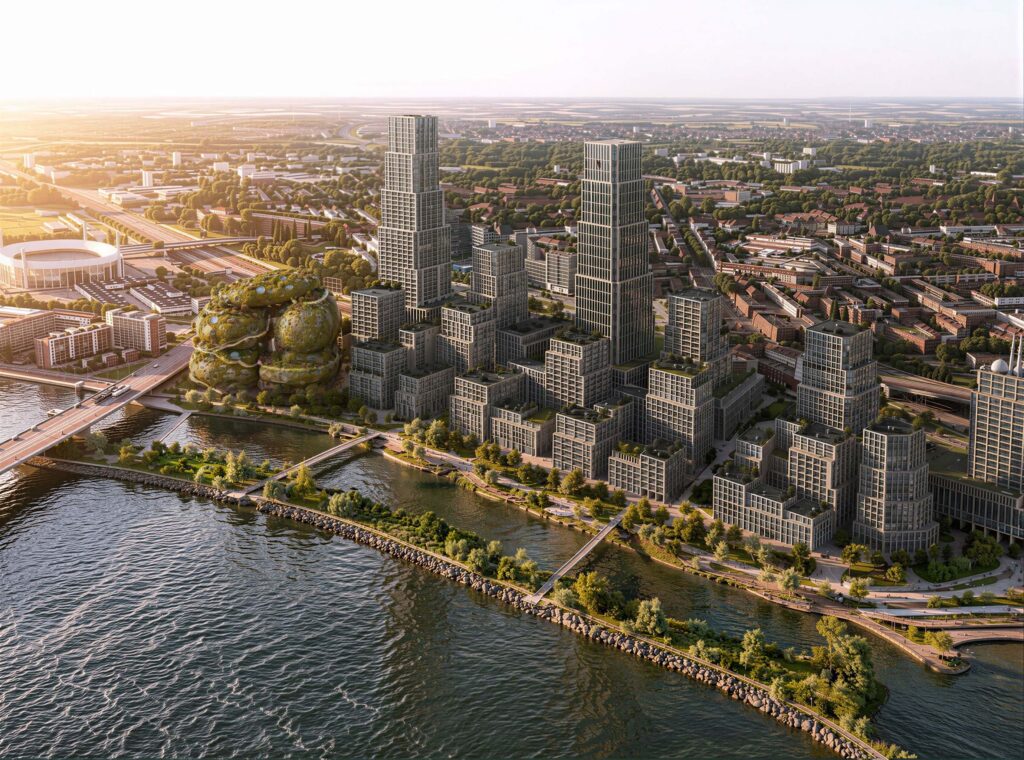
The project occupies a strategic site in Rotterdam South, where former harbour areas are being transformed into new urban districts. At the heart of this transformation is a vision for a greener Maas, surrounded by parks, water buffers, nature zones, and habitats.
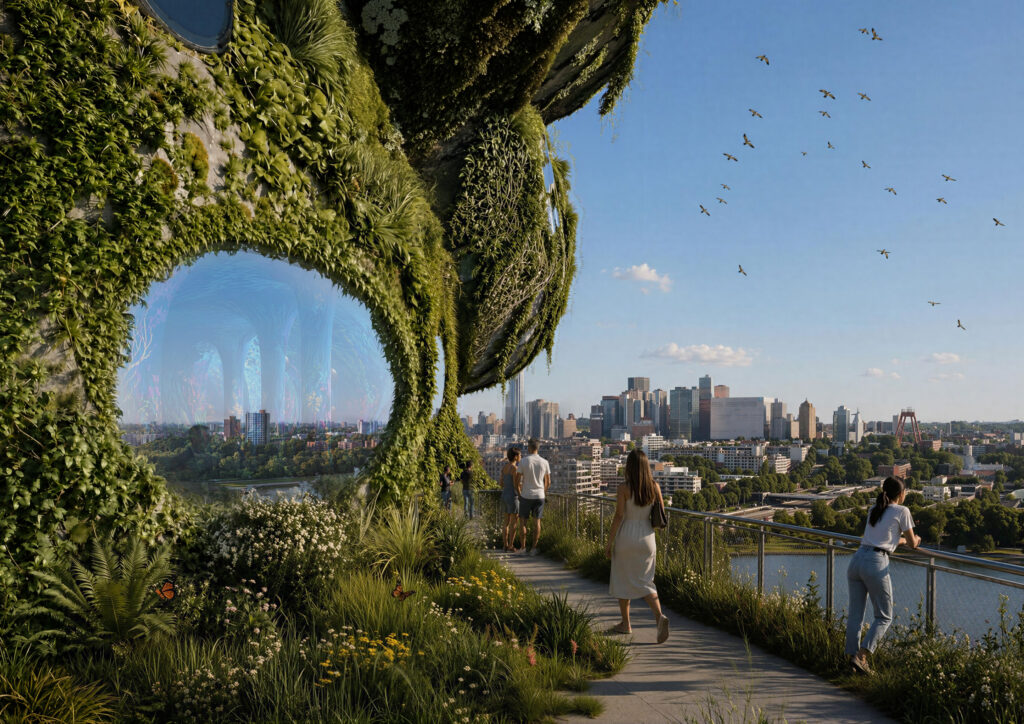
Rotterdam ROCKS! extends this landscape vertically. Instead of allowing the riverfront park to stop at the water’s edge, the project brings nature into the building and upward through a series of planted terraces, public routes, water systems, habitats, and outdoor spaces. The result is a three-dimensional park that connects the city, architecture, and river landscape.
Architecture as an Environmental System
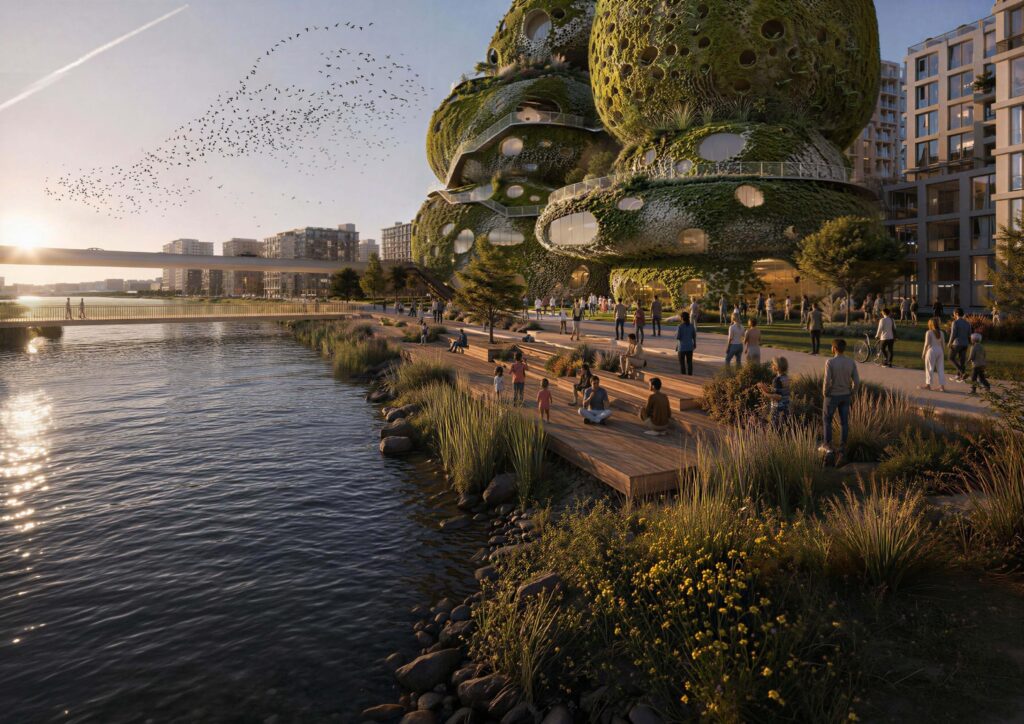
The project confronts an important contradiction: the most sustainable building is often the one that already exists. Rotterdam ROCKS! therefore cannot claim sustainability simply because it is dedicated to the subject. Its environmental impact must be actively reduced through low-carbon construction, circular materials, biodiversity, adaptability, water management, and energy efficiency.
The building is conceived as both destination and demonstration—a place where visitors can experience sustainability while questioning what future buildings could become. The ambition is to move toward architecture that is increasingly neutral, recyclable, regenerative, and metabolic.
This vision is captured in the concept of “Biotopia”: a future in which cities become vibrant ecosystems and architecture works with natural processes rather than against them. Rotterdam ROCKS! is imagined less as an isolated object and more as an organism that stores water, generates shade, supports vegetation, creates habitats, moderates microclimates, and adapts to changing technologies and environmental knowledge.
The Rocks and the Caves
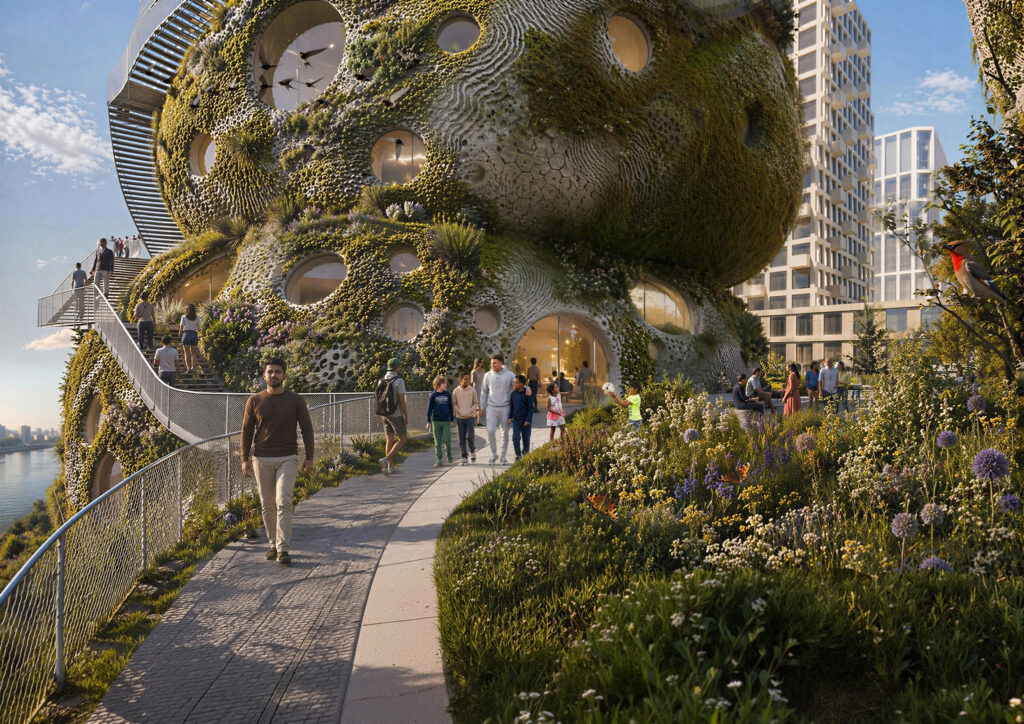
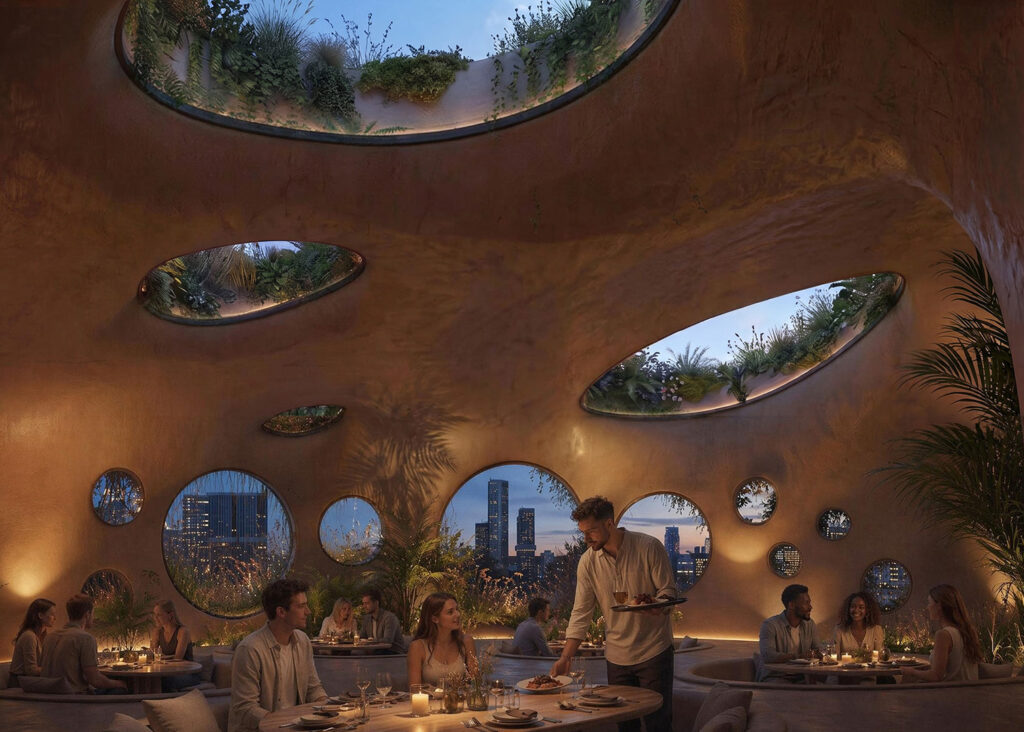
The required programme is organised into two interconnected towers—one primarily dedicated to exhibitions and the other to hospitality. These volumes are then sculpted into a family of rounded, rock-like forms.
Between them, open spaces introduce daylight, air, vegetation, and public circulation deep into the building. The resulting architecture creates generous terraces, overhangs, interior voids, and dramatic cave-like spaces while maintaining a compact and efficient structure.
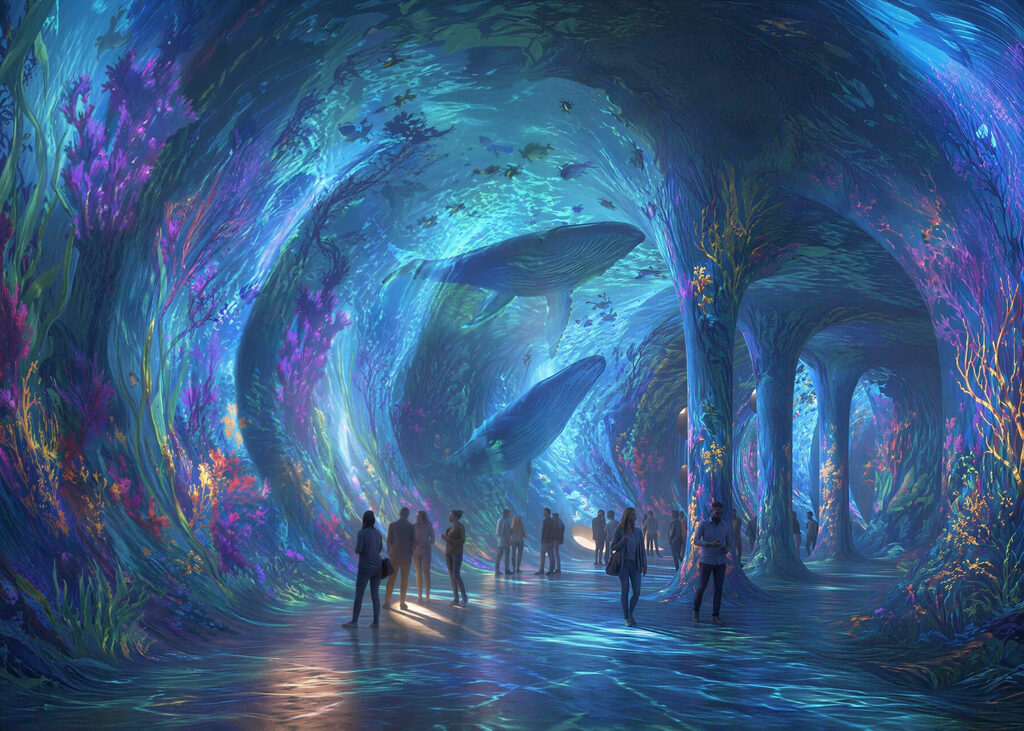
Each rock contains a central cave through which visitors move via stairs, ramps, lifts, terraces, and galleries. The journey becomes a continuous vertical exploration, shifting between enclosed spaces and open landscapes while revealing changing views of the Maas, Rotterdam, and the building itself.
The exterior becomes a three-dimensional river park, with planted terraces, cafés, restaurants, viewing platforms, and water features extending the riverside landscape upwards.
Microclimates and Biodiversity
The building’s rounded geometry also functions as an environmental tool. Different orientations create variations in sunlight, shade, wind, shelter, and exposure, producing a network of microclimates.
These conditions help determine where specific plants, soils, water systems, nesting areas, balconies, and habitats can perform most effectively. The building envelope is articulated with pockets, channels, terraces, and niches designed to retain and filter water, support roots and vegetation, and provide shelter for birds, bats, insects, and other urban wildlife.
Flat surfaces accommodate larger planted areas, while sloping and vertical surfaces create different conditions for vegetation. Overhangs provide additional opportunities for hanging plants and nesting habitats, transforming the building envelope into an active ecological landscape.
A Building That Learns
At MVRDV, environmental ambition is supported by measurement. Water retention, passive cooling, biodiversity, energy consumption, material use, maintenance, and long-term adaptability are considered as interconnected systems.
Rotterdam ROCKS! also serves as a testing ground for low-carbon and circular construction. Reused steel, lower-carbon concrete, bio-based materials, robotic fabrication, and large-scale 3D printing are explored alongside conventional techniques. Components are designed for disassembly and future reuse, transforming the building into a material bank whose resources can remain valuable beyond its first life.
A central Monitor makes these systems visible. Visitors can observe real-time information about energy production and consumption, water cycles, biodiversity, vegetation, temperature, maintenance, and material performance. Sustainability becomes something measurable and continuously tested rather than simply claimed.
Never Finished
Rotterdam ROCKS! reflects the spirit of a city famously described by the saying “Rotterdam is nooit af” — Rotterdam is never finished. The phrase captures a culture of experimentation, transformation, and continuous improvement.
In the same spirit, Rotterdam ROCKS! is not conceived as a finished architectural statement. It is an evolving piece of city and landscape—a living laboratory where architecture, people, technology, water, and nature can develop together.
By making its environmental systems visible and accessible, Rotterdam ROCKS! proposes a different model for sustainable architecture: not a static monument to sustainability, but a dynamic ecosystem that can learn, adapt, measure, and improve over time.
Photos credit: MVRDV